One order
An order opens on five tabs: Order, Payment, Purchase orders, Production and Shipping, so everything that happened to it sits in one place. An order that Fulfill Engine handles end to end shows only Order and Payment. Selecting a fulfillment tab that has nothing in it yet starts the work instead of showing you an empty tab. Production with no work order opens a new work order, Shipping with no shipment opens Buy shipping label, and Purchase orders with no purchase order but items still short opens a new purchase order with those items loaded. The Order tab lists every item with its decoration, color, sizes and price, and flags the lines that still need purchasing. Each fulfillment on it carries its own actions, and which ones appear depends on where it has got to:- Split fulfillment divides one fulfillment in two, so part can ship separately. It shows while the fulfillment is Unfulfilled, and only when it holds more than one item.
- New purchase order appears when items are short and no open purchase order already covers them. New work order appears on an unfulfilled fulfillment that has something to make.
- Print packing slip is always there. It reads Print receipt on a Fulfill Engine fulfillment.
- Buy shipping label becomes View shipment once a label exists. Buying a
second label for the same fulfillment moves into the
⋮menu, alongside Add tracking number. - Edit items sits in the
⋮menu. It opens a dialog where you change a line’s color, size, quantity or price, remove a line with the×beside it, or add one with Add item. Nothing is saved until you select Save changes. It appears until the fulfillment ships, and never on a Fulfill Engine fulfillment. Removing the last line deletes the fulfillment.
Editing items does not change what the customer paid. Changing a price here
charges and refunds nothing. The Payment tab, the customer’s receipt and the
packing slip each show a note saying totals reflect the original payment.
Some status changes email the customer. In production, Cancelled, In transit,
Delivered and Picked up each send a notification.
Payment
The Payment tab breaks the money down twice. What the customer paid is subtotal, shipping and tax. What you keep is revenue, minus fees, giving net. Where credits paid part of the fees, the Fees row says how much they covered. Refund payment refunds up to what is still refundable, in full or in part, and emails the customer to say so. On an order that came from a quote the button is Manage refunds instead, and it takes you to the quote’s Payments tab. An order paid past its total shows Overpaid by, with Refund the difference to return the extra.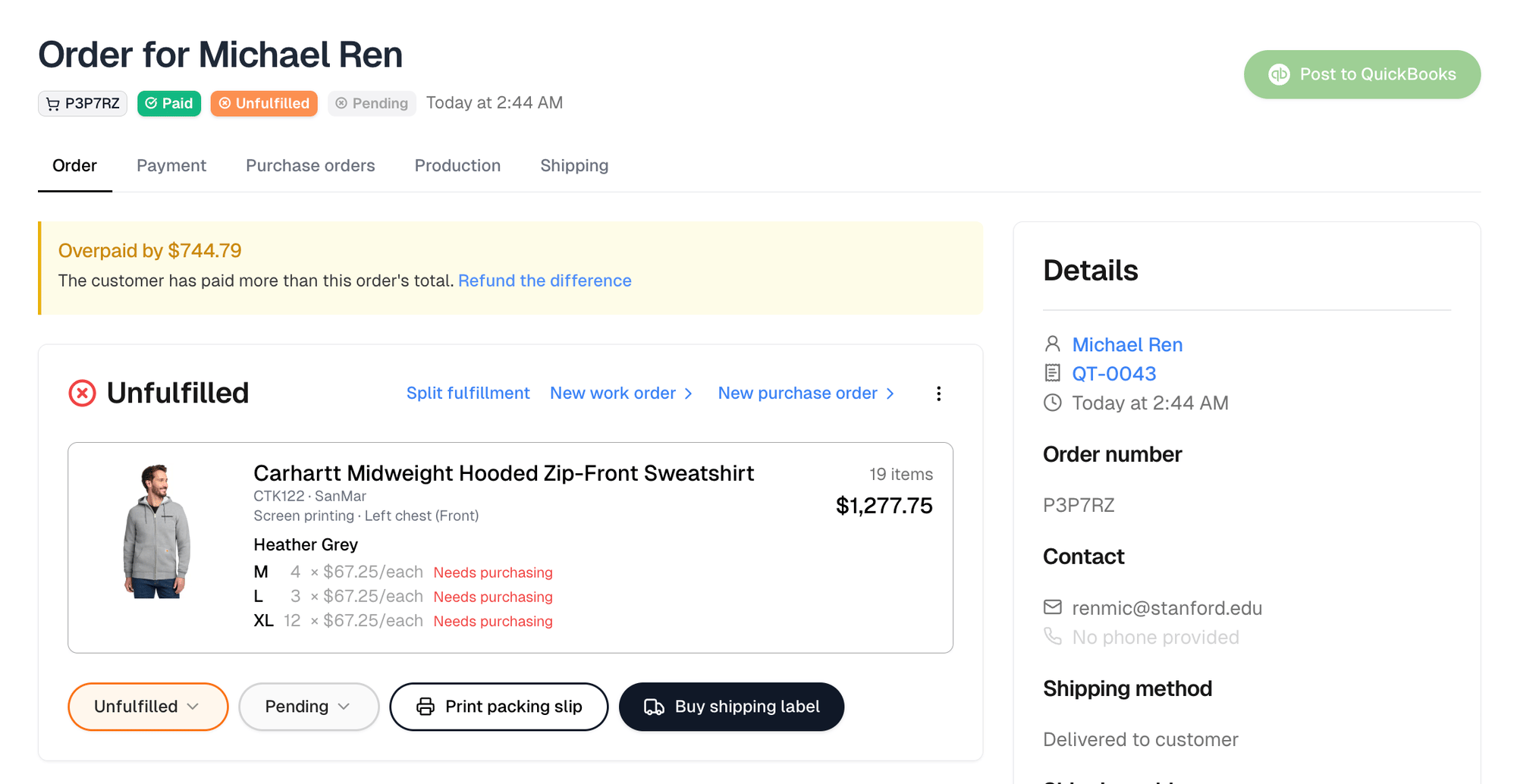
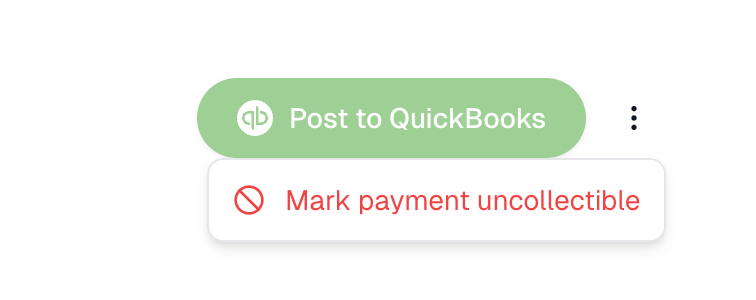
⋮ menu closes the balance. Reopen order for payment undoes it, and
a payment that arrives reopens it on its own. Only owners and admins see the menu.
With QuickBooks connected
Connecting QuickBooks Online adds a sync badge to each order and a Needs QBO sync filter. Neither appears otherwise.Acting on several at once
Select orders and the filter row is replaced by a toolbar with Print packing slips, Buy shipping labels, New purchase order, New work order, and controls to set Fulfillment status and Delivery status across the selection. Post to QuickBooks joins them when QuickBooks is connected. If any selected order already has a printed packing slip, the Print packing slips dialog says so before you print. New purchase order and New work order open the matching “New” page with the selected orders’ items already loaded, the same way the buttons on a single order’s Purchase orders and Production tabs do. See Acting on several at once and the note on moving items in Production. A bulk status change emails the customer on the same statuses a single change does. A selection carries across pages and clears when you change the filter or the search. It holds at most 200 orders, which is the packing-slip limit. Buying labels, creating a purchase or work order, and changing status all run on 100 at a time, and posting to QuickBooks on 50.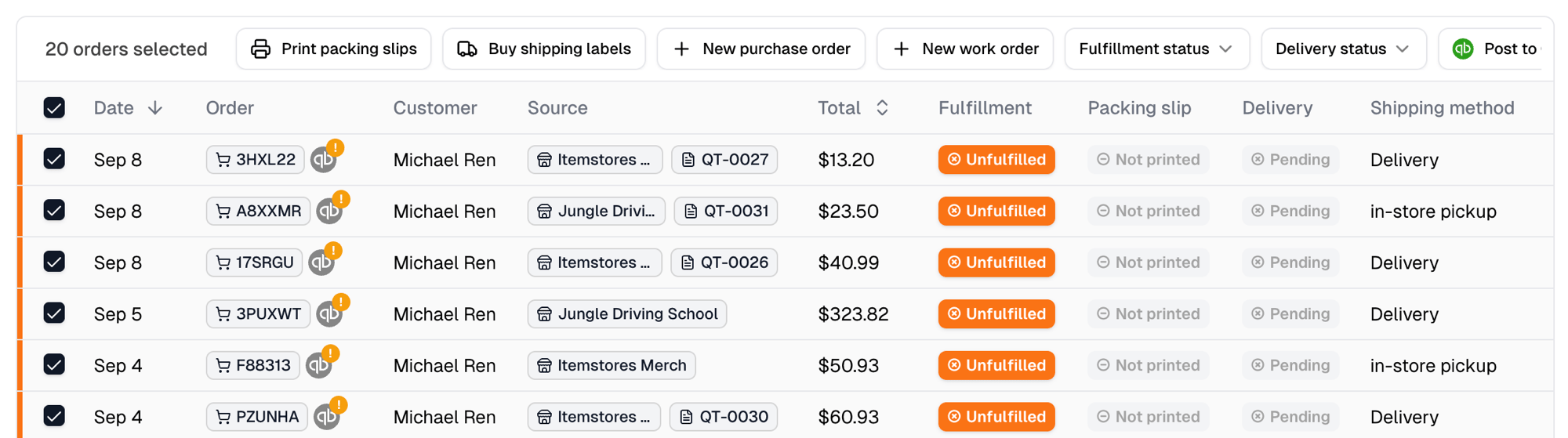
Marking an order picked up
Scan QR code opens your camera. Point it at the QR code on the customer’s receipt or packing slip and the order is marked as picked up. This is how a pickup-only store closes out an order without buying a label.Order numbers
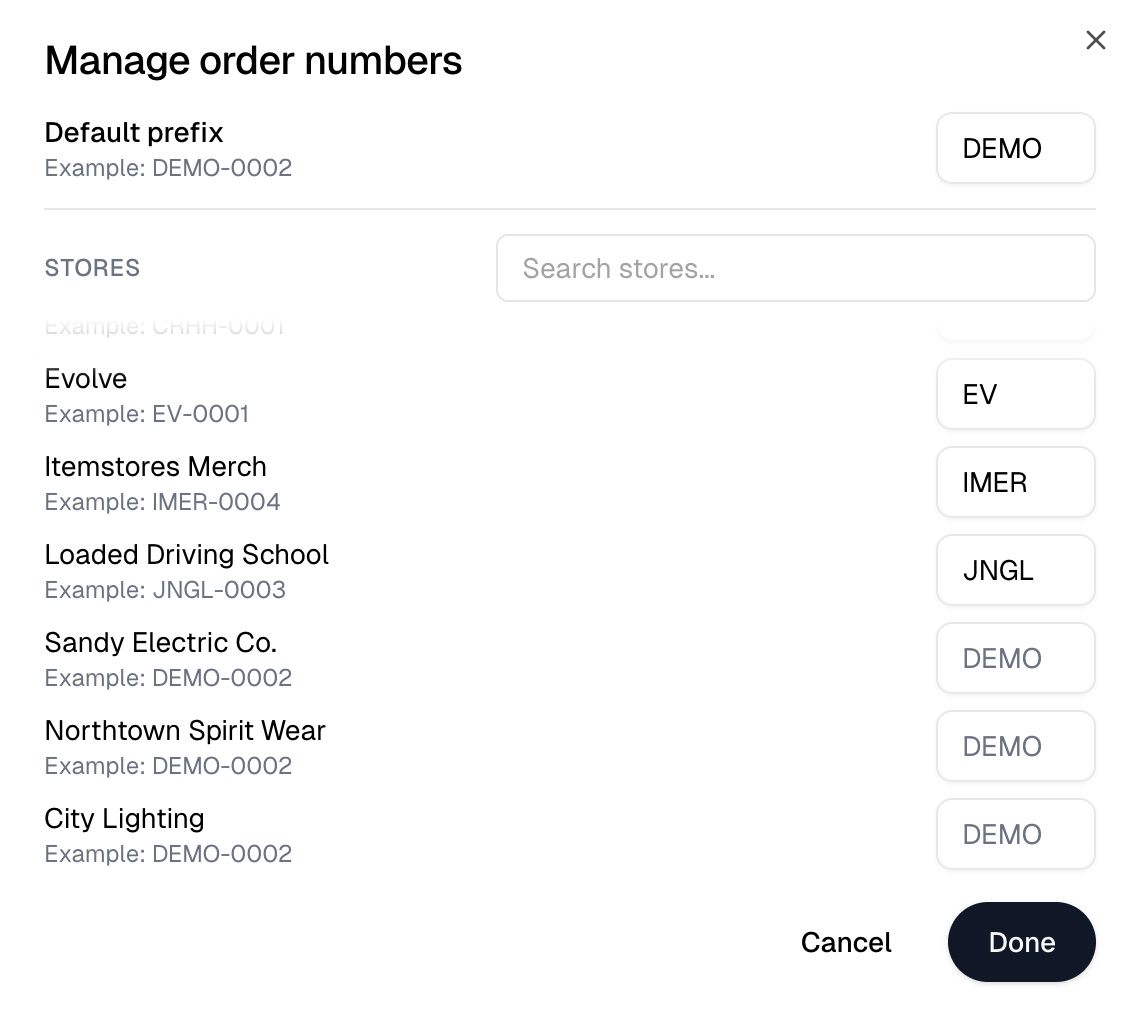
New orders are numbered with a prefix and a count, such asJDS-0001. Select
Order numbers to set a prefix for each store, and a default prefix for
everything else.
A store without its own prefix uses the default prefix, and so do orders from a
quote you create. With no default set, the prefix is ORD. A prefix is 2 to 4
letters.
Changing a prefix affects new orders only. Existing orders keep their numbers.