> ## Documentation Index
> Fetch the complete documentation index at: https://itemstores.com/help/llms.txt
> Use this file to discover all available pages before exploring further.
# Benefits of work orders
> One job that covers many orders, instead of chasing them one at a time
Orders arrive one at a time. The work does not. Ten orders across three stores
can be one press setup and one run, or ten of each, and the difference is
whether you batched them.
Left alone, the same design gets set up once per order, the same garment gets
pulled from the shelf in ones and twos, and nothing on an order tells you that
another order needs the identical run. A work order is where that gets
consolidated: one job, covering items from as many orders as you put on it.
## Batch by how you actually work
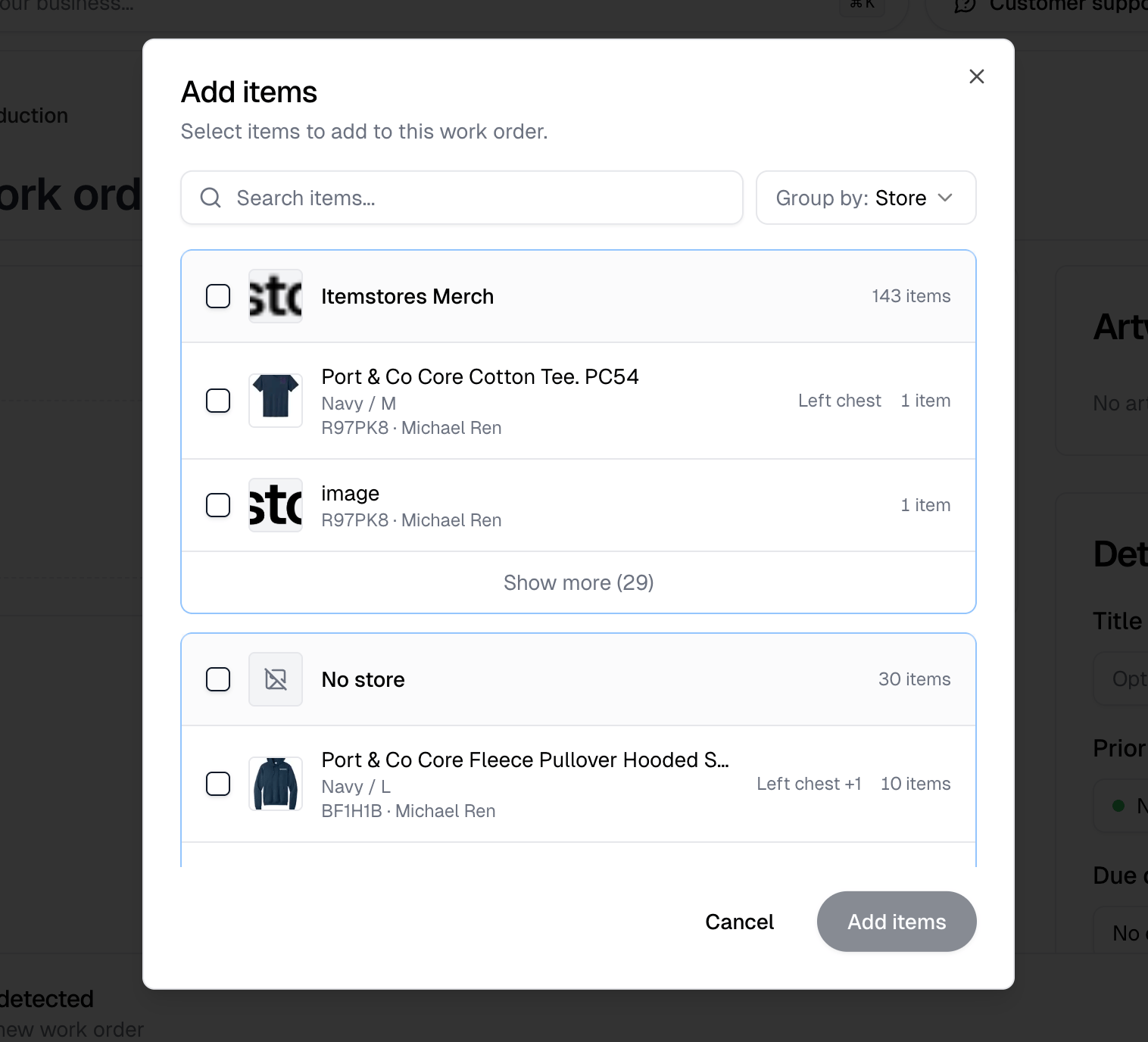
**Add items** on a work order groups what is waiting to be made by **Order**,
**Product**, **Artwork**, **Store** or **Decoration method**. A group's checkbox
takes the whole group at once.
That is the consolidation. Group by decoration method and one tick pulls in
everything being embroidered, whichever order it came from. Group by artwork and
one tick pulls in every garment carrying that design. Group by store and one
tick pulls in a whole team's orders.
Every row names the order and customer it came from, so you can see exactly what
you are pulling into the job.
 ## The artwork adds itself up
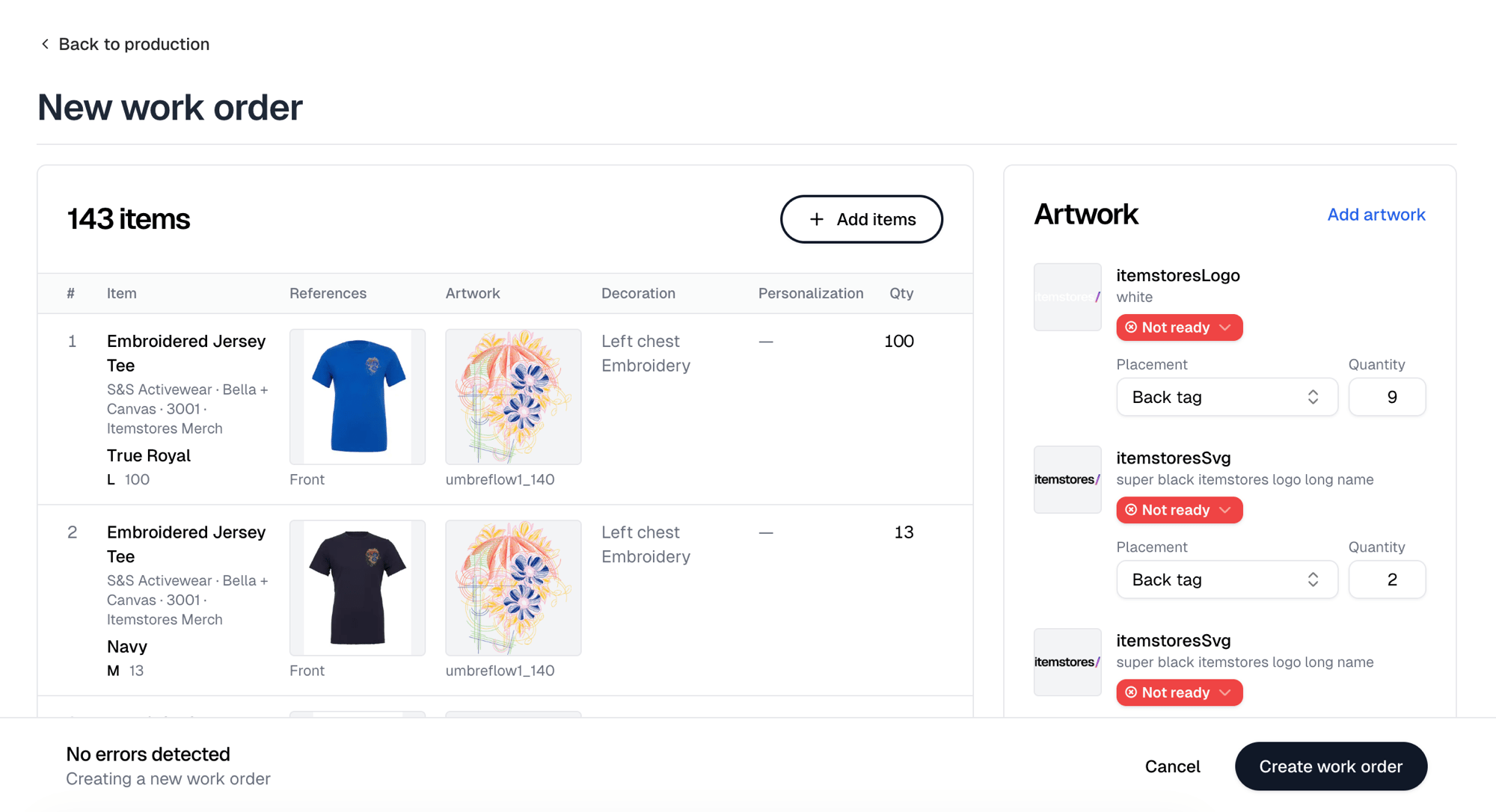
The Artwork panel fills itself in from the items you added: one line per
artwork, placement and colorway, with the quantity totaled across every order in
the job. You read one number per design instead of adding up ten orders by hand.
Readiness is tracked per design, not per order. An artwork is **Not ready**,
**Pending** or **Ready**, the board card shows a badge while any is outstanding,
and **Mark all ready** clears them together.
## The artwork adds itself up
The Artwork panel fills itself in from the items you added: one line per
artwork, placement and colorway, with the quantity totaled across every order in
the job. You read one number per design instead of adding up ten orders by hand.
Readiness is tracked per design, not per order. An artwork is **Not ready**,
**Pending** or **Ready**, the board card shows a badge while any is outstanding,
and **Mark all ready** clears them together.
 ## One move updates every order in it
Dragging the card to a new column rewrites the fulfillment status of every order
on the work order, and emails each customer whose status changed. Ten orders
advance on one drag.
Moving a card back to **Unfulfilled** recalculates each order from stock and
open purchase orders, so it can land on Needs purchasing or Awaiting PO. See
[Production](/help/knowledge-base/production) for what each column does.
## Nothing is made twice, and nothing is missed
An item already on a work order is not offered to another one, so two people
cannot each pull the same garment into their own job.
Items from a single order can still sit on different work orders, which is what
lets you batch by decoration method across orders. That order reads **Partially
in production** until the rest of it catches up, so a split order still reports
honestly.
## One document for the floor
**Print** produces the whole job as one document, with reference photos and the
size breakdown, rather than a stack of order printouts to reconcile at the
press.
Work orders are not the only way to move an order along. You can set a
fulfillment status directly on the order, or on a selection of orders in the
list. What a work order adds is that the work itself is batched, and the status
follows the job instead of being kept in step by hand.
## One move updates every order in it
Dragging the card to a new column rewrites the fulfillment status of every order
on the work order, and emails each customer whose status changed. Ten orders
advance on one drag.
Moving a card back to **Unfulfilled** recalculates each order from stock and
open purchase orders, so it can land on Needs purchasing or Awaiting PO. See
[Production](/help/knowledge-base/production) for what each column does.
## Nothing is made twice, and nothing is missed
An item already on a work order is not offered to another one, so two people
cannot each pull the same garment into their own job.
Items from a single order can still sit on different work orders, which is what
lets you batch by decoration method across orders. That order reads **Partially
in production** until the rest of it catches up, so a split order still reports
honestly.
## One document for the floor
**Print** produces the whole job as one document, with reference photos and the
size breakdown, rather than a stack of order printouts to reconcile at the
press.
Work orders are not the only way to move an order along. You can set a
fulfillment status directly on the order, or on a selection of orders in the
list. What a work order adds is that the work itself is batched, and the status
follows the job instead of being kept in step by hand.